Water heaters
Water heaters and tankless
Tank and tankless repair, replacement and maintenance, sized to how a household actually uses hot water rather than the biggest unit on the shelf.
Chapter 01
Tank or tankless on a Delaware County supply
A conventional tank heats and stores a set volume of water and keeps it hot around the clock, so recovery time between uses matters more than raw capacity for most households. A tankless unit heats water on demand as it passes through, which means no standby loss and no running out mid-shower behind a full tank, but it also means the unit only performs as well as the supply feeding it. Hard water is the variable that changes the calculation either way. It builds scale inside a tank over years, and it builds scale inside a tankless unit's heat exchanger faster than most homeowners expect, which is why a tankless system in this area needs a real descaling schedule, not an occasional flush whenever someone remembers.
Neither option is automatically the right call. A tankless unit is a real upgrade for a household that runs multiple showers back to back or has simply outgrown its tank's recovery rate. For a smaller household with steady, spaced-out use, a well-maintained tank does the job for less money up front and less maintenance discipline required to keep it running well.
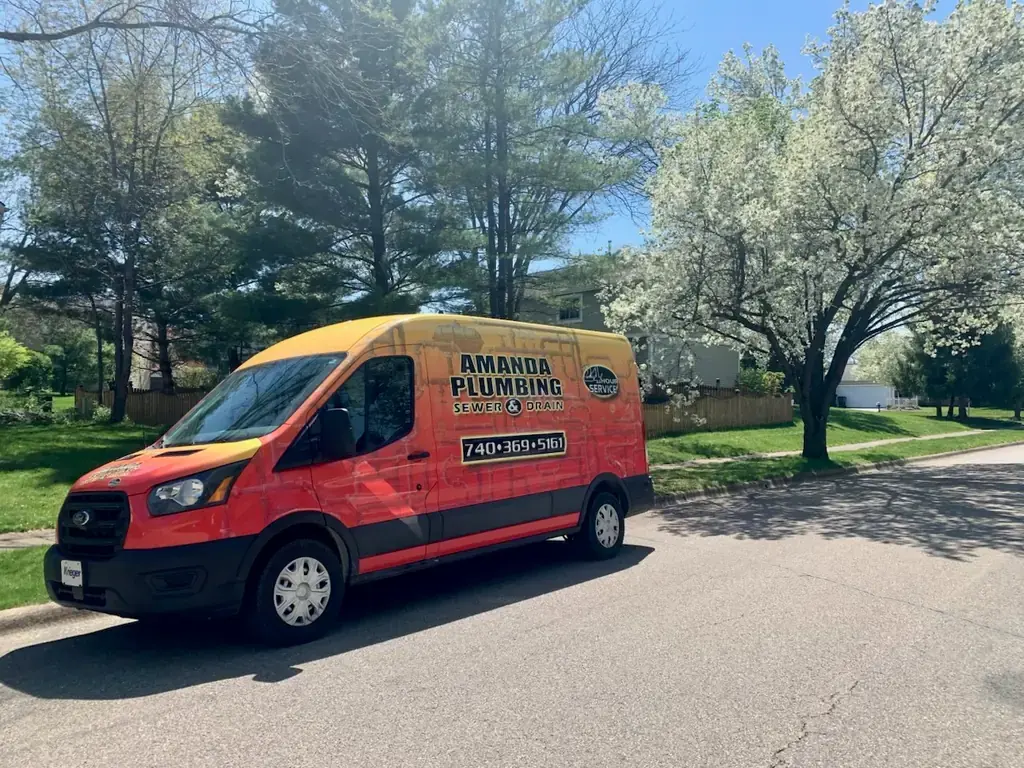
An Amanda Plumbing service van on a Delaware, Ohio street
Expansion tanks, and why a closed system needs one
Once a home has a check valve or a pressure-reducing valve on the main supply, the plumbing system is closed rather than open to the municipal line, which means it can no longer relieve the pressure created when water heats and expands inside the tank. An expansion tank absorbs that extra volume so the pressure has somewhere to go instead of stressing the water heater tank itself, the fittings, and every appliance downstream of it. Skipping one on a closed system is a common reason a water heater's pressure relief valve keeps dripping when nothing else about the heater is actually wrong.
Sizing and recovery, not just tank capacity
The number on the side of the tank tells you how much hot water is stored, not how fast the heater can make more once that runs out. Recovery rate is what actually determines whether a household runs out of hot water on a heavy morning, and a unit sized purely on gallon capacity without accounting for recovery can still leave the last shower cold. Bigger is not automatically better either. An oversized tank costs more to run every single day for capacity a household never actually uses, so we size to real usage patterns rather than defaulting to the largest unit that fits the space.
Maintenance that actually buys years, and knowing when it's over
Flushing sediment out of a tank once a year, checking the anode rod before it is fully consumed, and testing the temperature and pressure relief valve are the three things that reliably extend a water heater's working life, and none of them are expensive next to a full replacement. A rusty tank, water that comes out with a metallic taste or color, or a unit that is simply old enough that a repair would be throwing money at a tank on borrowed time are the honest signs a heater is done rather than needing another repair. We tell homeowners which situation they're actually in instead of defaulting to whichever answer sells more.
Amanda Plumbing Sewer & Drain has been serving Delaware County since 1995, licensed under Ohio license #23169. Call (740) 369-5161.