General plumbing
Sump pump repair and replacement
Pump repair, replacement and battery backup for basements that take water when the power or the pump itself lets go.
Chapter 01
When the pump is running and the basement still takes water
This is the call that confuses people most, because the pump sounds fine. It cycles, it hums, and the basement floods anyway. Three things cause it almost every time. A float switch can hang up on the side of the basin or get tangled in its own tether, so the pump never actually gets the signal to kick on until the water is already over the crock. A check valve on the discharge line can fail open, which lets the water the pump just pushed out fall straight back down the pipe into the pit, so the pump runs constantly and never gets ahead of it. Or the impeller inside the pump housing has picked up enough silt and grit off the bottom of the pit that it is spinning without actually moving much water anymore.
We test all three before we replace anything. A float that just needs re-seating or a check valve that needs swapping is a five-minute fix next to a full pump replacement, and there is no reason to sell a homeowner a new pump when the actual failure is eight dollars of hardware.
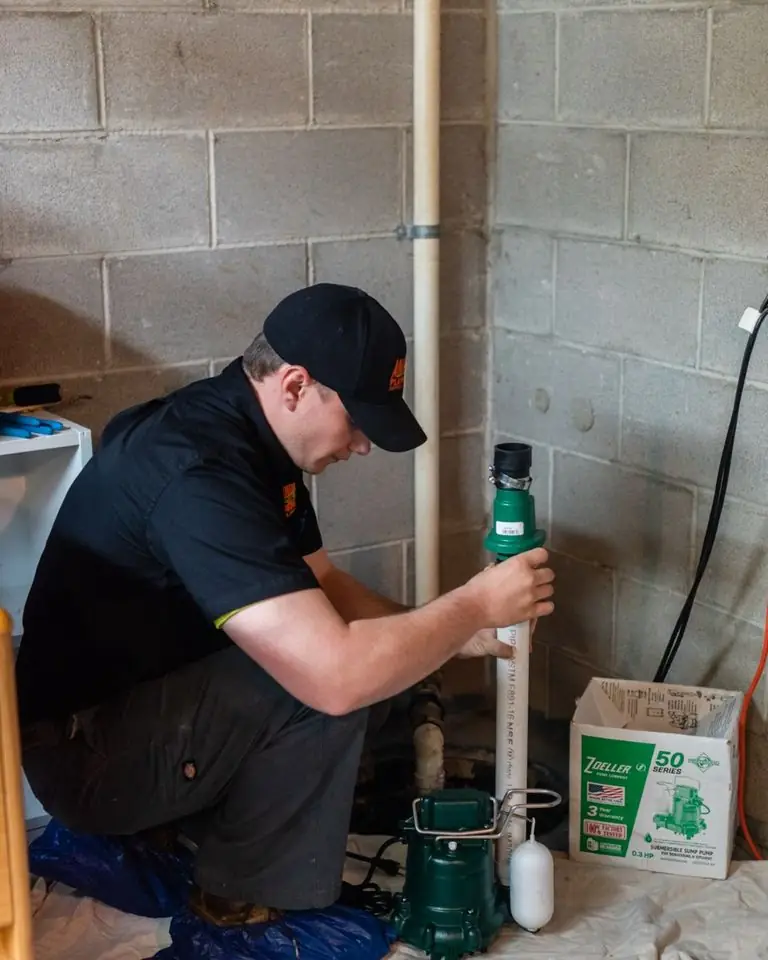
An Amanda Plumbing technician installing a Zoeller sump pump in a Delaware, Ohio basement
Battery backup, and why it matters here specifically
A primary sump pump runs on house power, and the basement floods that actually cause damage tend to arrive with a storm, which is exactly when Central Ohio loses power. That is the whole case for a battery backup system in one sentence: the storm that fills your pit is the same storm that can knock the pump offline right when it has the most work to do. A backup unit sits on the same discharge line and takes over automatically when the primary loses power or fails outright, running off a dedicated battery until either power returns or the battery runs down.
We size the battery to the pump and the basin, not a generic number off a shelf, because a battery that is undersized for how much water is actually coming in during a real storm buys you an hour when you needed six.
Discharge lines, downspouts and where they actually go wrong
A sump pump is only as good as where the water goes after it leaves the basin. Discharge lines that run above grade freeze in winter and block the pump's only outlet, which forces water back toward the check valve under pressure it was never built for. Lines tied into a downspout drain can crush under a driveway or a section of walkway if they were laid without enough cover, and a line that simply daylights too close to the foundation will do exactly what the pump was installed to prevent, sending the water it just removed right back toward the wall it started at.
Repair or replace, and how we actually decide
Most residential sump pumps have a working life measured in cycles as much as years, and a pump that has been running through every heavy rain for a decade has earned its wear regardless of the calendar. If the motor itself is original and the pit has a history of nuisance failures, replacement is usually the honest answer even if the immediate problem is a float. If the pump is a few years old and the failure traces to one part, a straight repair gets you back running for a fraction of the cost, and that is what we recommend when the numbers say that is the right call.
Amanda Plumbing Sewer & Drain is licensed, bonded and insured under Ohio license #23169. Call (740) 369-5161.