Drain and sewer
Drain cleaning and clogged drains
Cabling and hydro jetting on kitchen lines, bathroom drains and main stacks, with a camera run down the line when a clog keeps coming back.
Chapter 01
What actually blocks a drain around here
Most of what we clear falls into three buckets, and they are not the same job even though they all present as "the sink won't drain." Kitchen and laundry lines back up on wipes, grease and food solids that cool and harden inside the pipe long after they leave the sink. Older neighborhoods along the Columbus Pike corridor still run clay sewer laterals, and Delaware County's heavy clay ground gives tree roots every reason to work their way into a joint and keep growing once they find water and warmth. Hard water adds a third failure mode on its own: scale builds up along the inside wall of a pipe over years, narrowing it until a flow that used to clear fine starts backing up on far less debris than it used to take.
Telling those three apart matters before we touch a cable, because the fix for one does nothing for the others. Grease responds to being cut and flushed out. Roots have to be cut back and then dealt with directly, not just pushed through. Scale is a pipe condition, not a clog, and cabling through it over and over just buys a shorter interval each time.
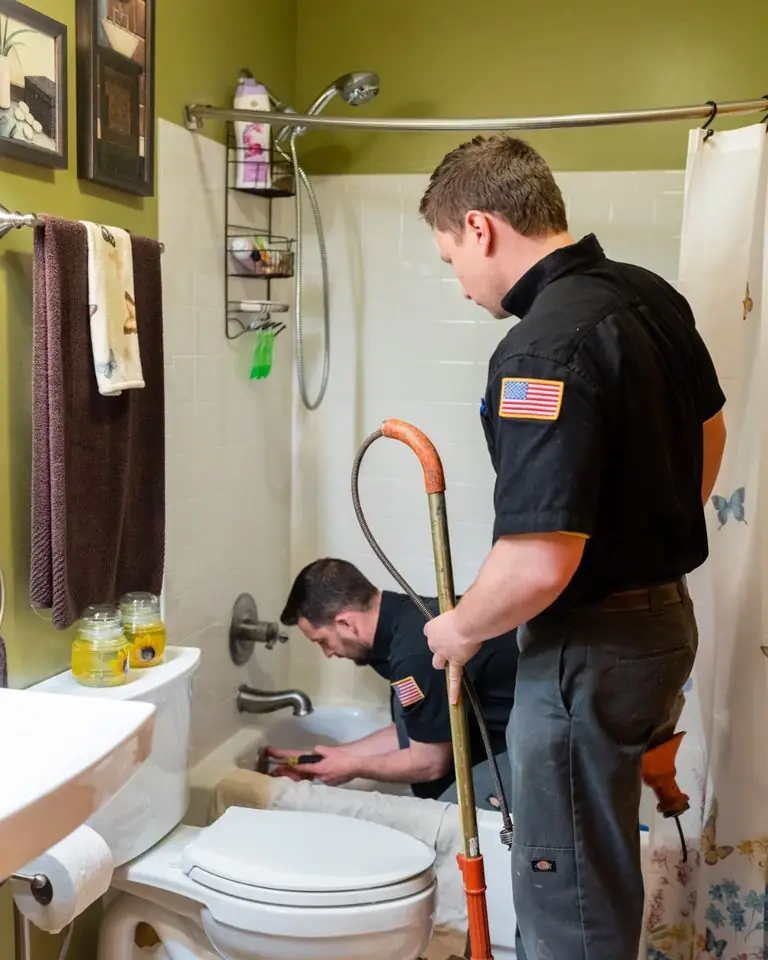
Two Amanda Plumbing technicians working a bathroom drain line in a Delaware, Ohio home
Cable versus hydro jetting
A cable machine spins a coiled steel line down the pipe and punches or grinds a hole through whatever is blocking it. For a grease plug or a solid mass that is exactly the right tool: it is fast, it does not need much room to set up, and it opens the line back to flowing in minutes. What it does not do is clean the pipe wall. It bores a channel through the blockage and the rest of the buildup stays right where it was, which is why a cabled line that was already coated in scale or grease residue tends to slow back down sooner than the homeowner expects.
Hydro jetting runs a high pressure water line down the pipe with a nozzle that fires water backward as it is pulled through, scouring the full diameter of the pipe wall on the way out rather than just drilling a path through the middle. That makes it the right call on a line with years of grease buildup or scale, and it is also how we cut root intrusion back rather than just punching past it. It is the wrong tool on a pipe that is already cracked, badly offset or collapsing, because pressure into a compromised joint can make a bad section worse instead of clean.
What the camera shows before we quote
On anything more than a simple kitchen clog, we run a camera down the line before we recommend cabling, jetting or anything bigger. That is not an upsell step, it is how we know which of the above we are actually dealing with. A camera shows whether roots have opened a joint, whether the pipe itself has bellied and is holding standing water, or whether the whole line is just coated and needs a jet rather than a repeat cable call. Quoting off a guess instead of a picture is how homeowners end up paying for the wrong fix twice.
Whether it is going to come back
A drain that clogs once in a while, in the same place a piece of grease or a wad of hair usually collects, is a cleaning problem and cabling or jetting solves it. A drain that backs up again on a schedule, weeks apart, in the same spot every time, is a pipe problem wearing a clog's clothes: a root that grows back, a joint that keeps opening, a belly that keeps collecting the same debris no matter how clean the pipe is when we leave. When we see that pattern we say so directly rather than running the same cable call a third or fourth time, because the honest next step at that point is a camera inspection and a real look at the line, not another visit that treats the symptom again.
Amanda Plumbing Sewer & Drain has been running Delaware County drains since 1995, licensed under Ohio license #23169. Call (740) 369-5161.