Backflow
Backflow testing, repair and installation
Testing, repairing and installing the backflow preventer that keeps water flowing one direction only, from the main into the building and never back the other way.
Chapter 01
What a backflow preventer is actually stopping
A backflow preventer sits at the point where a building's plumbing meets the public water main, and its only job is to make sure water moves one way. Under normal pressure that is easy. Water pressure drops for a moment, a main breaks nearby, a fire hydrant opens down the street, and without that assembly in place, whatever is sitting in the building's own pipes can get pulled backward into the supply line instead. On a house that might be lawn chemicals sitting in an irrigation line. On a commercial building it can be a lot more, depending on what is connected to the water system.
That is the whole reason the assembly exists, and it is also why it is not something to leave alone once it is installed. A check valve inside is doing mechanical work every time pressure shifts, and like anything mechanical it can wear, stick, or fail to seat the way it should.
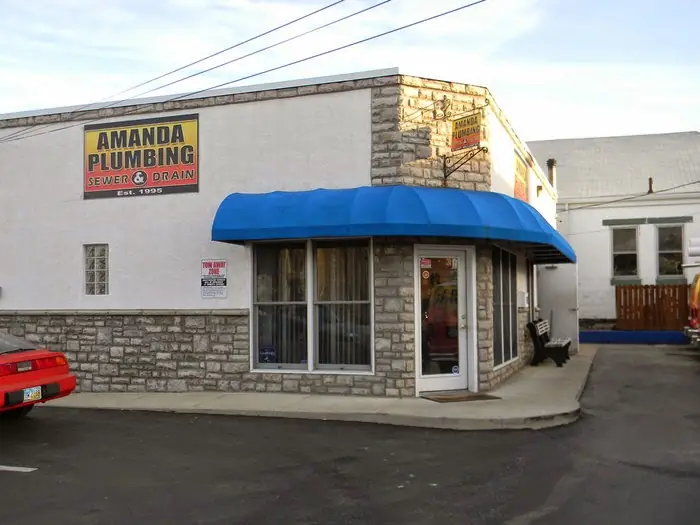
Amanda Plumbing storefront in Delaware, Ohio with a blue awning and a sign reading Est. 1995
Who needs a test and how often
Homes with an irrigation system, businesses on certain water connections, and any property where the water authority has flagged a cross connection risk are typically required to have their backflow assembly tested on a recurring basis, generally annually, though the exact rule depends on the jurisdiction and the water provider involved and we would rather point a customer to their own water authority for the specific requirement than guess at one. What we can say plainly is that a test is a short visit: we check that the assembly holds and releases pressure the way it is supposed to, and we tell you straight away if it does not.
A failed test is not automatically bad news. Most of the time it means a valve needs cleaning or a seal needs replacing, not that the whole assembly has to come out. We would rather explain what actually failed than let a customer assume the worst.
Chapter 03
Repair versus replacing the assembly
Backflow assemblies fail in a handful of predictable ways. Internal seals wear out and stop sealing tight, springs weaken and slow the check valve's response, or debris in the line gets caught where it should not be and holds a valve slightly open. Most of that is a repair, not a replacement: clean it, reseat it, replace the worn part, and retest.
Replacement comes into play when the body of the assembly itself is corroded or cracked, when it is old enough that parts are no longer serviceable, or when the size or type installed does not match what the property actually needs anymore. We would rather repair an assembly that can be repaired. A new assembly only gets recommended when the old one genuinely will not hold up to another season.
The paperwork side of a backflow test
A backflow test that never gets filed is a test that does not count for anything. Most water authorities that require testing also require the result to be reported to them, or to whoever asked for it, on their own timeline and their own form. We fill that part out and make sure the result gets where it needs to go rather than leaving a customer to chase down a form after the fact.
If a property manager or a business owner is not sure whether their water provider requires this at all, that is a fair question to bring to us before we show up. We would rather confirm what is actually required for a specific address than test something nobody asked us to test.
Amanda Plumbing Sewer & Drain is licensed, bonded and insured under Ohio license #23169. Call (740) 369-5161.