Drain and sewer
Sewer line repair and replacement
A camera inspection goes down the line before we quote anything, because a lot of Delaware County's older neighborhoods still run clay laterals that decades of root intrusion have been working on.
Chapter 01
Reading the camera before anyone digs
Every sewer line problem shows up differently on the monitor, and the diagnosis is what decides the price, not a guess made from the symptom at the fixture. A break shows as a gap in the pipe wall where the camera's own light disappears into open ground. A belly, where a section of pipe has sagged and now holds standing water instead of draining, shows as a flat dark pool that the camera has to push the lens down into rather than a continuous dry pipe. An offset joint looks like a lip or a step where one section of pipe no longer lines up with the next, catching paper and solids on the edge every time. Root intrusion is the most obvious on camera: a mass of fine roots filling part or all of the pipe's diameter at a joint, sometimes just a fringe, sometimes a solid clog of root hair that water has to push through.
We do not quote a repair off a phone description or a slow drain alone. The camera tells us which of those four conditions we are actually looking at, and each one calls for a different scope of work.
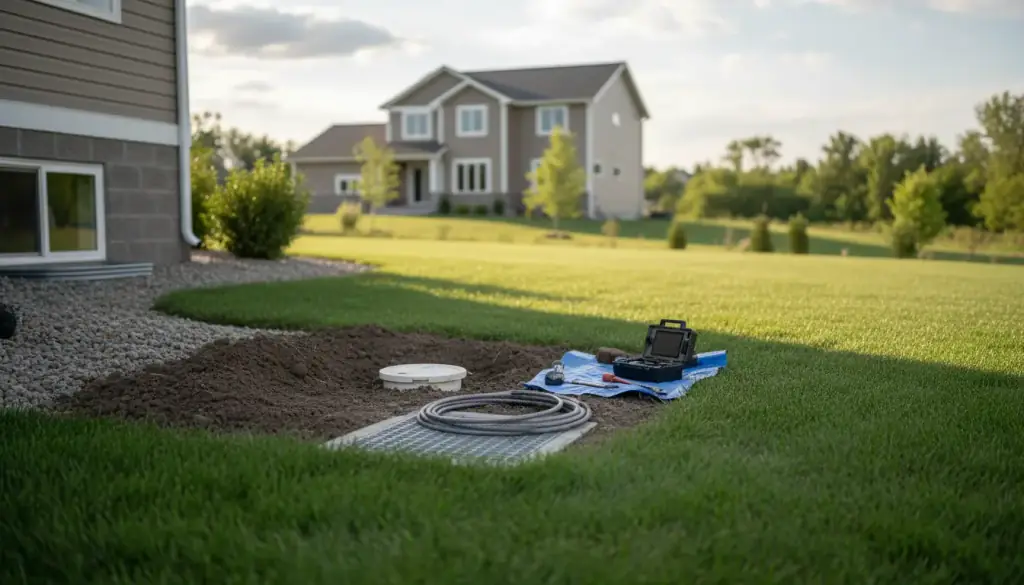
Sewer cleanout and foundation drain access at a Delaware, Ohio property
Spot repair versus full replacement
A single break or offset joint in an otherwise sound line is usually a spot repair: dig to that one section, cut it out, replace it, and tie back into pipe that is still in good condition on either side. A line with root intrusion at multiple joints, a belly that has settled the pipe's grade, or clay pipe that has simply reached the end of its service life is a different conversation, because patching one section of a line that is failing throughout just moves the next call a few months down the road.
Age and material drive that call as much as the camera does. Clay pipe from the era a lot of Delaware County's older homes were built in was never as forgiving of ground movement or root pressure as what goes in today, and once it starts failing in one place it is often close behind in others. We tell people the difference plainly: fix what actually needs fixing, and say clearly when the honest answer is to replace the line rather than keep repairing pieces of it.
Sewer camera inspection as maintenance
Not every camera run ends in a repair recommendation. For a line that is still structurally sound, sewer line cleaning paired with a camera inspection is the maintenance path: clear whatever buildup or early root growth has started, confirm on camera that the pipe itself is still in good shape, and give the homeowner an honest read on how long that line is likely to hold before it needs real work. That is a cheaper, faster visit than a repair call, and it is the right one when the line earns it.
Putting the yard back
When a repair does mean opening the ground, our own excavation crew does the digging, not a subcontractor we are coordinating around. That means one crew owns the diagnosis, the dig and the cleanup, and we leave the work area the way we found it when the job is done rather than handing the yard back looking like a construction site.
Amanda Plumbing Sewer & Drain is BBB accredited with an A+ rating and has been named Delaware Gazette's Readers' Choice Best Plumber six years running. Call (740) 369-5161.