Why a sump pump can run constantly and still let the basement flood
A running pump and a wet basement usually point to one specific part, not a dead motor.
September 9, 2026 · 4 min read
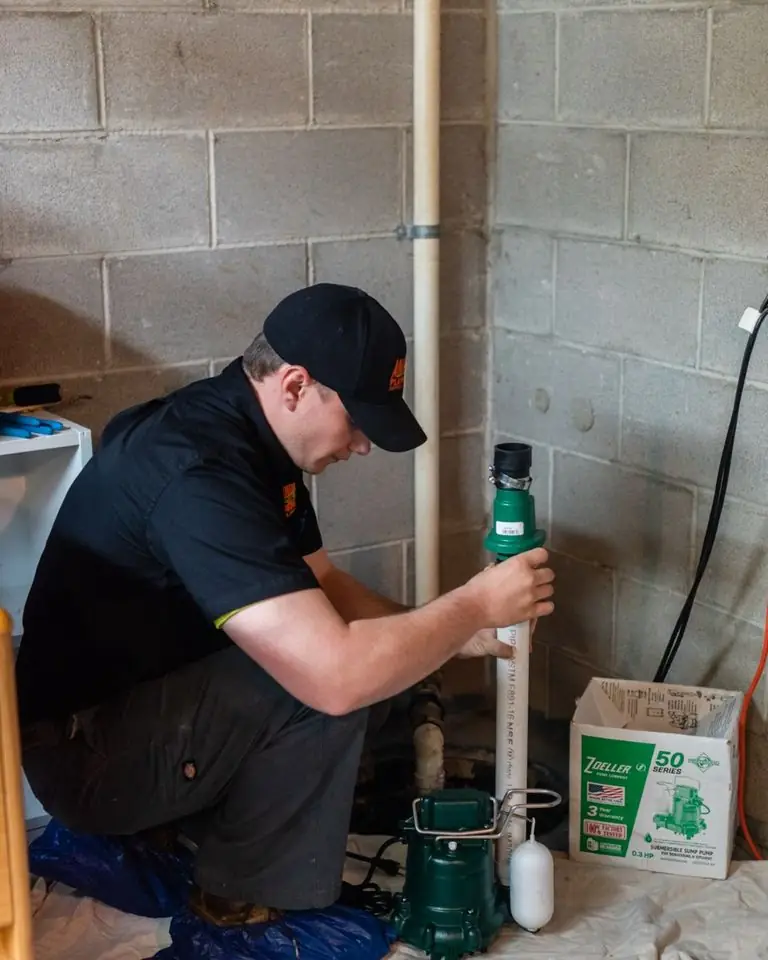
A sump pump is one of those pieces of a house that nobody thinks about until the basement is wet. It sits in a pit, mostly ignored, and it's supposed to quietly do its job every time groundwater rises. When it doesn't, the failure is rarely as simple as the pump being broken. Usually something specific went wrong, and once you know what to look for, most of it is fixable before it becomes a bigger repair.
This matters more in Delaware County than in a lot of places, because the heavy clay soil here doesn't drain well on its own. Water that would soak into sandier ground elsewhere tends to sit and push toward the path of least resistance, which is often a basement with a struggling pump.
A pump that runs and a basement that still takes on water
One of the more confusing situations for a homeowner is a pump that's clearly running, humming away in the pit, while water keeps rising in the basement anyway. That's almost always a sign the pump is moving water, just not enough of it, or not to where it needs to go. It's rarely a reason to assume the whole unit is dead.
Before replacing anything, it's worth figuring out whether the problem is the pump itself, the switch that tells it when to turn on, the valve that should stop water from flowing back in, or the pipe carrying water away from the house. Each of those has a different fix, and most of them cost far less than a new pump.
The float switch is the first thing to check
The float switch is what tells the pump to turn on as water rises and off once the pit is empty. If it gets stuck, tilted, or tangled against the side of the pit or a power cord, the pump either never turns on or never turns off. A stuck float is one of the most common reasons a sump pump appears to have failed when the motor itself is fine.
It's a simple thing to check and a simple thing to fix, which is exactly why it's worth ruling out before assuming the whole unit needs replacing.
A check valve that lets the pit refill itself
The check valve sits in the discharge line and is supposed to stop water from flowing back down into the pit once the pump shuts off. When it fails or gets installed backward, the pump ends up doing the same work twice, pushing the same water out only to have it drain right back in. That shows up as a pump that seems to run constantly without ever getting ahead of the water.
A discharge line that's frozen, crushed, or aimed at the wrong place
The pipe carrying water away from the pump matters as much as the pump itself. In winter, a discharge line that exits above ground can freeze solid, and a frozen line has nowhere for the water to go except back toward the pit or, worse, back into the basement. A line that's been crushed by settling soil or an ill placed landscaping project causes the same result year round.
Where that line actually empties matters too. A discharge line that dumps water ten feet from the foundation is doing its job. One that empties right next to the house is just recirculating the same water back toward the basement wall.
Downspouts that undo all the pump's work
This one isn't technically part of the sump system, but it behaves like it is. Gutters and downspouts that dump roof water within a few feet of the foundation are feeding the exact problem the sump pump exists to solve. In Delaware County's clay soil, that water doesn't soak away, it sits against the foundation and finds its way toward the basement, which means the pump is fighting a battle that better downspout drainage would have prevented in the first place.
What delaying the repair actually costs, and why a battery backup matters
A sump pump problem that gets put off tends to get discovered during the exact kind of storm that makes it worst, often with the power out at the same time. A pump with no battery backup is completely dependent on grid power, and a lot of basement flooding happens during storms that knock the power out before the rain even stops. A battery backup keeps the pump running through exactly the situation it was installed for.
The basement isn't the only thing at stake. Standing water against a foundation, repeated over multiple storms, is what turns into cracked block, settling, and repairs that cost far more than fixing a float switch or a discharge line would have.
If your pump is running but the water isn't going anywhere, or your basement floods every time the power does, it's worth having someone actually look at the whole system rather than just swapping the pump and hoping. Give us a call at (740) 369-5161 and we'll walk through what's actually happening in your pit and your yard.
Amanda Plumbing Sewer & Drain, (740) 369-5161
Call (740) 369-5161More articles
Six things to check before you hire a local plumber
A quick guide to separating an established plumbing company from a truck with a magnet sign, before you need one in an emergency.
Signs your plumbing system is due for more than a quick fix
How to tell an aging plumbing system's warning signs apart from a one-off problem.